

“The only word I can use to describe it is ‘incomprehensible’.” A professional colleague used that statement to summarize a significant, months-long, disruptive event that her organization continues to navigate, with no end or resolution in sight. Incomprehensible, and yet she and her leadership team must act.
What about you and your company? Have you experienced something unpredictable, something that was previously unthinkable, or seemingly intractable? The conversation is no longer unusual. We are hearing similar stories across a variety of industries. These experiences are occurring much more frequently, and they are fueling anxiety and uncertainty for leaders, leadership teams, and employees alike.
Consider these statistics: In 2024, Gallup reported that 39% of working adults experienced a lot of worry the previous day and 37% reported high stress1. Moreover, a recent American Psychological Association study found that nearly two-thirds of Americans are anxious about current global events. Forty percent of employed adults express concern about job security, with 54% reporting that job insecurity impacts their stress levels2. In addition, 77% of adults are worried about the economy3.
High emotional and cognitive load, accelerating change, rising worry, and declining clarity are not isolated conditions. They are signals of the environment in which we are now operating.
This is the BANI world.
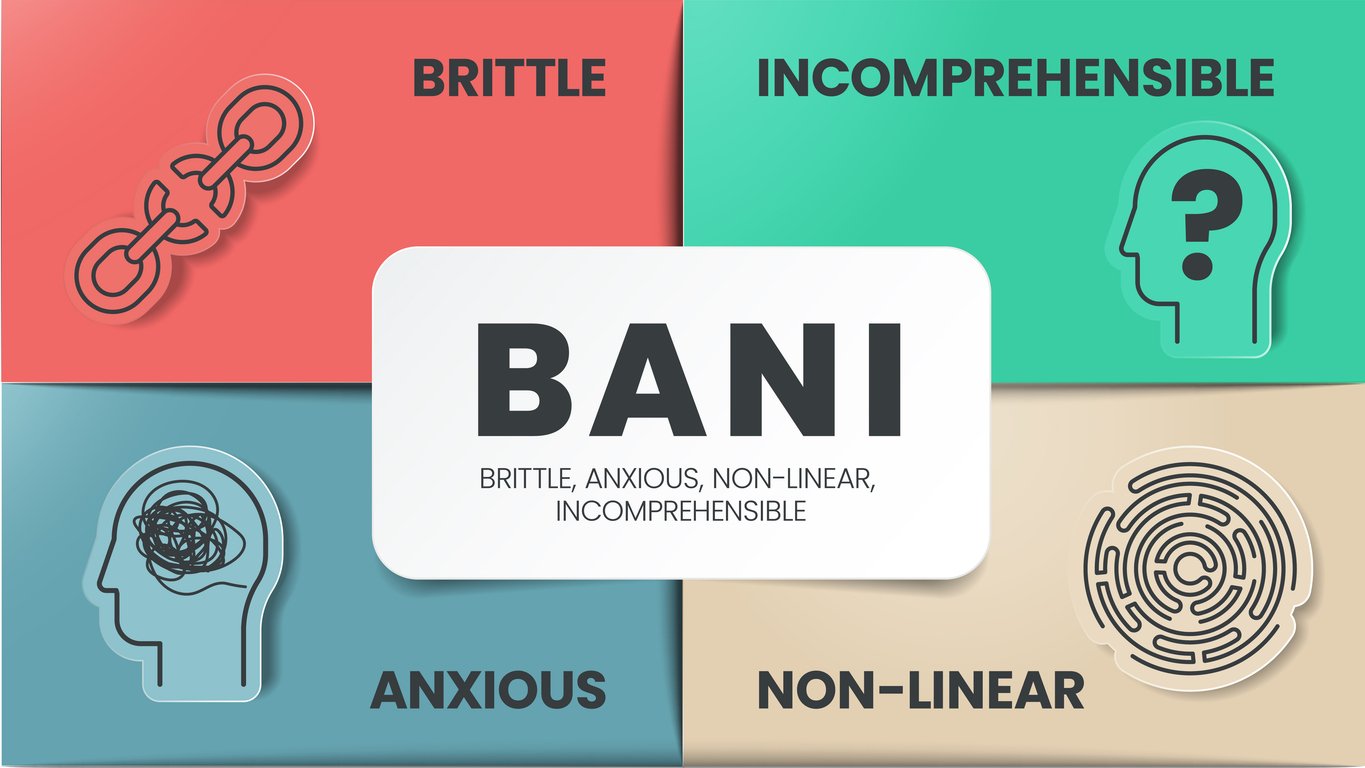
BANI describes an environment that is Brittle, Anxious, Nonlinear, and Incomprehensible, and it is not a passing phase. BANI is the context in which leadership decisions will be made for the next decade and beyond.
What is BANI and Why does it Matter?
Jamais Cascio, a Distinguished Fellow at the Institute for the Future (IFTF) and co-author of Navigating the Age of Chaos, introduced the BANI framework in 2018. It provides leaders with a way to make sense of emerging conditions and, more importantly, to act more effectively within them. For decades, IFTF has helped leaders use strategic foresight, scenarios, and future-back thinking to prepare for uncertainty and shape more resilient futures.
BANI builds on and extends the earlier VUCA (Volatile, Uncertain, Complex, and Ambiguous) framework developed by the U.S. Army War College in the late 1980’s. While VUCA helped leaders navigate volatility and complexity, today’s conditions demand a more precise lens. As futurist Bob Johansen has noted, VUCA is no longer sufficient to describe the world leaders are facing.
As leaders, recognizing this BANI environment and responding to it isn’t optional. It’s a strategic imperative. So, what does BANI look like?
Understanding the Four Conditions of BANI
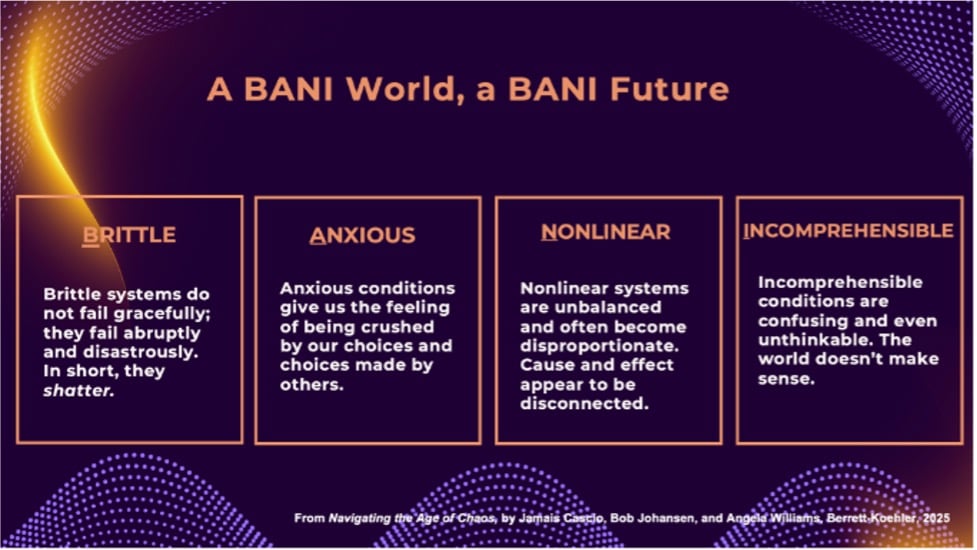
Brittle describes systems that were once perceived as strong but are now increasingly vulnerable to disruption or failure. For many organizations, Brittleness shows up as strategies that are too rigid, processes that did not anticipate rapid growth, talent models stretched beyond capacity, or supply chains disrupted by external forces such as tariffs or geopolitical shifts.
Anxious reflects the human response to uncertainty. Leaders, employees, clients, and customers may feel unsettled by rapid technological change, automation and AI, shifting business models, and economic instability. Anxiety increases when people lack clarity, context, or confidence in what lies ahead.
Nonlinear conditions are those in which cause and effect no longer follow predictable patterns. Small changes can have a big impact, while significant efforts may yield minimal results. Thus, traditional planning approaches become less reliable.
Incomprehensible refers to situations where events are difficult to fully understand or explain, even in hindsight. The belief that we can fully predict or control outcomes becomes increasingly unrealistic.
BANI is a challenging frame. If misunderstood, it can create indecision or stall movement. However, when intentionally reframed, it becomes a powerful tool for growth, innovation, and results.
Seizing the Opportunities in Positive BANI
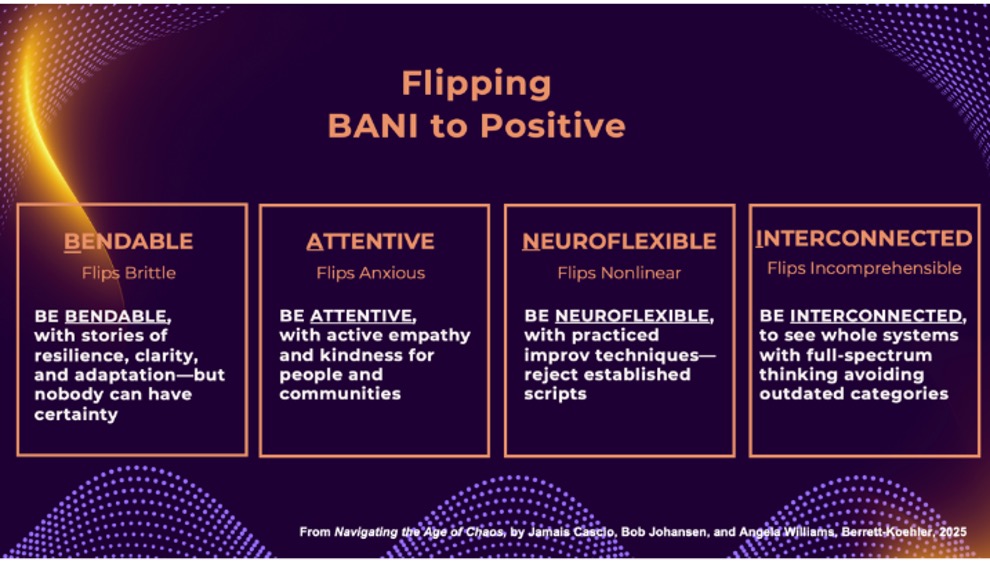
A BANI environment presents opportunity alongside risk. Leaders can use a positive or “flipped” BANI approach to guide their organizations and people through uncertainty rather than being driven by it.
Each dimension of BANI has a corresponding positive capability that leaders can intentionally develop at both the organizational and individual levels.
From Brittle to Bendable
In a brittle environment, clarity of direction matters more than certainty of execution. Bendable organizations reduce fragility by reimaging how work and decisions flow, staying clear on where they are going, and being flexible in how they get there.
Organization
Strategies
- Use scenario planning to identify potential disruptions and stress-test current business, operating, and talent models
- Design and/or clarify decision-rights frameworks and accountability that can scale with growth or as conditions change
- Build redundancy and contingency plans for critical roles and processes
Individual
Strategies
- Focus on outcomes rather than controlling the process
- Adapt plans quickly without overcorrecting or self-criticizing
- Protect personal capacity through realistic pacing and boundaries
Bendable organizations anticipate change, absorb shocks, and adjust without losing momentum.
From Anxious to Attentive
At the heart of all businesses are people. In uncertain conditions, anxiety is a natural response. Practicing attentiveness through an empathetic, human-centered approach not only reduces anxiety but also stabilizes performance and unlocks discretionary effort.
Organization
Strategies
- Communicate frequently and consistently, clarifying priorities and acknowledging uncertainty
- Reduce “noise” and enhance focus by limiting competing initiatives during periods of change
- Align leaders around a shared messaging so expectations are consistent
Individual
Strategies
- Listen. Practice active and empathetic listening before responding or solving
- Put yourself “in the other person’s shoes” to consider what they might see or feel from their viewpoint
- Use simple presencing practices (e.g., pausing, breathing, getting curious) to sustain clarity and composure
Intentional attention lowers anxiety, builds trust, and helps people stay focused and effective even when the environment feels unsettled.
From Nonlinear to Neuroflexible
When conditions are nonlinear, learning becomes more valuable than perfect solutions. Neuroflexibility combines mental and emotional agility, enabling leaders to adapt, learn, and remain effective as the environment continues to change.
Organization
Strategies
- Lead change with appreciative and generative questions that surface strengths and possibilities
- Use small, low-risk experiments to learn and adapt quickly
- Build regular learning reviews or “after-action” debriefs to capture insight and adjust course
Individual
Strategies
- Respond to uncertainty with curiosity, using questions to explore and discover
- Use “Yes, and” thinking to build on what is emerging
- Reflect regularly on what is working, what you are learning, and how you are adapting
Neuroflexible leaders foster organizations that learn faster and turn uncertainty into forward momentum.
From Incomprehensible to Interconnected
In BANI, “incomprehensible” often signals that key perspectives are missing. Opportunity emerges when leaders widen their view, engage the right people, and intentionally cultivate connection and collaboration.
Organization
Strategies
- Involve cross-functional perspectives and multi-level viewpoints early in problem-solving or key decision-making
- Design forums that promote collaboration rather than siloed execution
- Connect strategy discussions to the lived experience of the work across the organization, promoting full-systems engagement
Individual
Strategies
- Invest intentionally in relationships that support both your performance and well-being
- Seek diverse perspectives to improve judgment and reduce blind spots
- Cultivate connections with peers, mentors, or trusted advisors to stay grounded and reduce isolation
Interconnected systems and leaders absorb disruption more effectively by engaging the right people early, improving judgment, coordination, and shared understanding.
Leading Forward
The future may be uncertain, but leadership still calls for thoughtful action. When the Positive BANI capabilities are practiced at both the organizational and individual levels, uncertainty becomes a source of resilience and strength rather than an emotional and cognitive drain.
Organizations gain direction, performance, and long-term sustainability. Individuals regain clarity, energy, and confidence in how they lead and show up each day.
To engage the future with intention, select the strategies that resonate most and put them into practice. In a BANI world, advantage doesn’t come from predicting what’s next. It comes from leaders and organizations designed and developed to act, learn, and adapt together.
- Gallup. State of the World’s Emotional Health: 2024 Report. Gallup Global Analytics, 2024.
- American Psychological Association. “Annual Mental Health Poll Reveals Americans Anxious About Current Events; 40% of Employed Worried About Job Security.” APA News Release, May 15, 2025.
- Reuters. “U.S. Workers Are Becoming More Stressed About Finances, BofA Survey Shows.” Reuters, September 3, 2025.
Breaking Through Questions
- Where are we handling uncertainty better than we might think, and what are we doing there that we should repeat elsewhere?
- What do we need to stay clear on right now, and where do we need to give people more flexibility in how the work gets done?
- What feels unclear or frustrating today, and whose perspective could help us see it more clearly?
- What is one small change we could make in how we lead or communicate that would make the next 30, 60, or 90 days easier for our people?
